🥚 How Much Protein Do You Really Need a Day?
































Most people eat either far too little protein or far more than their body can use — and almost nobody knows which side they are on. The answer is not a magic number like 100 g a day: it is one multiplication, your weight in kilograms times a factor between 1.2 and 2.2.
This guide shows you the ladder, works it out for four real people, turns the number into a day of food, and names the four mistakes that waste most of the protein people eat.
1. Your number is weight × a factor — here is the ladder
Protein is the only macronutrient your body cannot store for later: fat waits in body fat, carbohydrate waits as glycogen, but amino acids are used, recycled or burned the day they arrive, while muscle, enzymes and skin are rebuilt continuously. That is why protein needs are a daily figure that scales with body weight.
Our Protein Calculator multiplies your weight by a factor from an activity ladder — here it is, worked out at 75 kg:
- Sedentary — 1.2 g/kg: 90 g a day, 23 g per meal.
- Light activity — 1.4 g/kg: 105 g a day, 26 g per meal.
- Moderately active — 1.6 g/kg: 120 g a day, 30 g per meal.
- Very active — 1.8 g/kg: 135 g a day, 34 g per meal.
- Athlete — 2.0 g/kg: 150 g a day, 38 g per meal.
- Building muscle — 2.2 g/kg: 165 g a day, 41 g per meal.
Per meal is the daily total split across four meals. The ladder starts above the bare minimum on purpose: the Recommended Dietary Allowance (RDA), set by the US National Academies, is 0.8 g per kilogram a day — 60 g for a 75 kg adult — the minimum that avoids deficiency, not an optimum. The 1.6 g/kg rung is the sweet spot for regular trainers, and research finds the benefit topping out around 1.6–2.2 g/kg; past that, the extra is burned as fuel.
2. Four people, four numbers
Here is the ladder on real bodies:
- Aisha, 75 kg, very active (1.8): 75 × 1.8 = 135 g a day, about 34 g per meal. At 4 calories a gram, that is 540 calories — roughly a quarter of a 2,200-calorie day.
- Danish, 60 kg, building muscle (2.2): 60 × 2.2 = 132 g a day, 33 g per meal. A lighter body on the top rung lands almost exactly where Aisha does.
- Usman, 85 kg, athlete (2.0): 85 × 2.0 = 170 g a day, 43 g per meal — 680 calories of protein.
- Fatima, 50 kg, light activity (1.4): 50 × 1.4 = 70 g a day, 18 g per meal. A small person does not need a bodybuilder's portion.
Protein is personal arithmetic: two people can eat the same 100 g and one is 30 g short while the other is 30 g over. Check your calories with the Calorie Calculator — your protein target lives inside that total.
3. What 135 g looks like on a plate
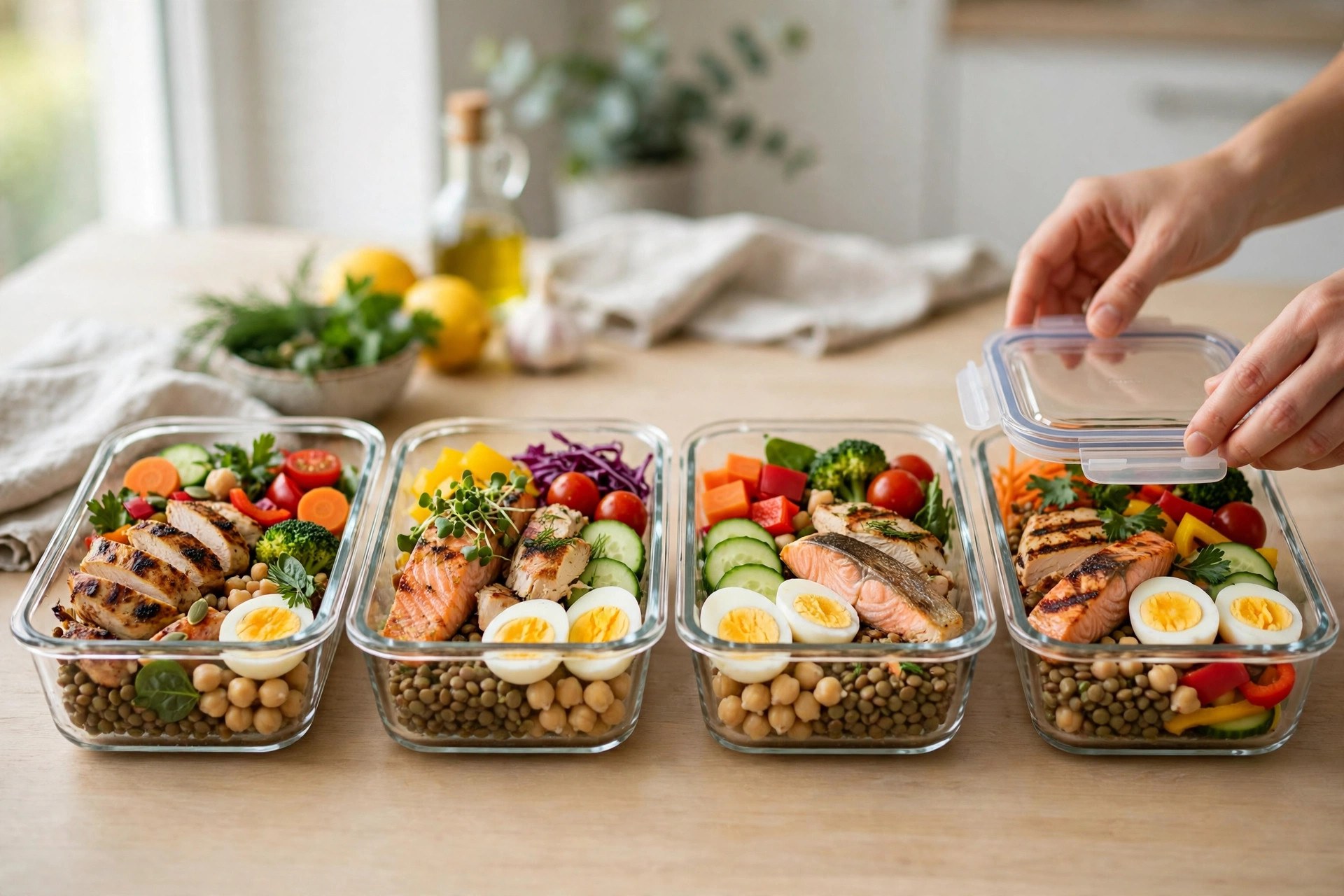
Here is Aisha's 135 g as an actual day:
- Breakfast — 30 g: 2 eggs (12 g) + 180 g Greek yogurt (18 g).
- Lunch — 40 g: 130 g grilled chicken breast (about 40 g of protein).
- Dinner — 40 g: 160 g salmon (40 g).
- Snack — 25 g: one scoop of whey protein (25 g).
30 + 40 + 40 + 25 = 135 g — the target, hit exactly. Prefer plants? Swap the lunch for 200 g cooked lentils (18 g) plus 100 g paneer (18 g) and a glass of milk (about 9 g): roughly 45 g. And remember: 100 g of chicken is not 100 g of protein — it is 31 g. Food weight and protein grams are different numbers, and confusing them is the most common counting error.
Quick reference: 1 large egg 6 g · 100 g Greek yogurt 10 g · 100 g chicken breast 31 g · 100 g salmon 25 g · 100 g cooked lentils 9 g · 100 g paneer 18 g · 1 scoop whey 25 g.
4. Spread it out — the per-meal rule
Muscle rebuilding responds to protein in pulses: research generally puts the useful dose per meal at 20–40 g, so spreading the day across three or four meals works better than saving everything for one enormous dinner. The ladder's four-meal split lands at 23–41 g per meal at 75 kg — right in the zone.
Age raises the per-meal bar: older muscle responds less eagerly, so after about 60 the question shifts from "more per day" to "enough per meal" — servings towards 35–40 g. A 70 kg adult over 60 at 1.6 g/kg needs 112 g a day, about 37 g across three meals, exactly in that zone.
What about the famous "window" after a workout? The evidence says it is wide: total daily intake explains most of the outcome, and a protein meal within a few hours either side of training covers the rest. Hit the daily figure first. For the full picture, the Macro Calculator sets your protein inside a complete calorie split.

5. Four mistakes that waste your protein
Using the RDA as a target. 0.8 g/kg is the floor that avoids deficiency, not an optimum: at 75 kg it is 60 g, while an active person's lowest rung is 90 g and a trainer's sweet spot is 120 g. Treating the floor as the goal leaves you 30–60 g short every day.
Eating it all in one meal. A 135 g dinner does not do the work of four 34 g meals: the process responds meal by meal, and the surplus from one giant serving is burned, not banked.
Dieting without raising protein. In a calorie deficit your body is tempted to break down its own muscle along with fat, and higher protein is the standard defence: an 80 kg person cutting at 2.0 g/kg needs 160 g a day against 96 g at the sedentary 1.2 — a 64 g difference that decides whether the weight lost is fat or muscle.
Counting food weight as protein. "I ate 200 g of chicken, so that is 200 g of protein" is wrong by a factor of three: 200 g of chicken breast carries about 62 g. Count the grams on the label, not the grams on the scale.
Two exceptions: people with kidney disease should consult a doctor first, and during pregnancy and breastfeeding needs rise and are better calculated with a clinician.
The 30-second check
Multiply your weight in kilograms by 1.6: 70 kg gives 112 g, 80 kg gives 128 g, 90 kg gives 144 g. Train hard? Use 2.0. Barely move? Use 1.2. Then open the Protein Calculator for the exact figure, the Calorie Calculator for the total it sits in, and the BMI Calculator for your weight context. One multiplication, and the guessing ends.
Frequently asked questions
How much protein do I need per day?
Multiply your weight in kilograms by 1.2–2.2 g, depending on activity. At 75 kg that is 90 g a day if you are sedentary, 120 g if you train regularly and 165 g if you are building muscle. The 0.8 g/kg RDA is the minimum that avoids deficiency, not a target for active people.
Is 2.2 g/kg of protein too much?
For healthy adults it is the top of the commonly used range, aimed at muscle building and protecting muscle while dieting; research generally finds no extra muscle benefit beyond it. The exception is kidney disease — consult a doctor first, because protein targets there are a medical decision.
Can I eat all my protein in one meal?
You can, but your body uses it better spread out: muscle rebuilding responds meal by meal, and doses of 20–40 g switch it on usefully. Four meals of 23–41 g (at 75 kg) beat one 135 g dinner.
Do vegetarians need protein powder?
No. Lentils, chickpeas, paneer, dairy, eggs and soy foods reach the same totals — powder is a convenience, not a requirement. What matters is the daily total and its rough spread across meals.
References
- All worked figures in this post were computed with the free calculators at metacalculator.org — Protein Calculator, Macro Calculator, Calorie Calculator and BMI Calculator (accessed 13 November 2026). The ladder, per-meal splits and worked examples match the Protein Calculator's own outputs.
- Recommended Dietary Allowance for protein, 0.8 g/kg/day: National Academies of Sciences, Engineering, and Medicine, Dietary Reference Intakes for Energy, Carbohydrate, Fiber, Fat, Fatty Acids, Cholesterol, Protein, and Amino Acids (2005).
- Per-food protein values are typical USDA FoodData Central values (large egg about 6 g; chicken breast about 31 g/100 g; salmon about 25 g/100 g; Greek yogurt about 10 g/100 g; cooked lentils about 9 g/100 g; milk about 3.4 g/100 ml) — brands and cooking methods vary slightly.
- Related reading on this site: "How Many Calories Should You Eat a Day? Find Your Number in 2 Minutes" (6 November 2026) and "Understanding BMI: What Your Number Really Means" (23 October 2026).