⚖️ BMI Calculator: 7 Common Mistakes That Give You the Wrong Number








































Your BMI says 27.8 — overweight. Or does it? One wrong unit, one careless rounding, and the same body reads 22.9 and healthy, or 10.4 — not a human being at all.
BMI is just weight in kilograms divided by height in metres squared, so every slip in either input lands straight in the answer. Here are the seven mistakes that give people the wrong number — each with the exact figures — and the one-minute routine that gets it right.
1. Mixing up the units — kilograms vs pounds
This is the biggest error of all, and the easiest to make: the scale reads pounds, the calculator expects kilograms, and nobody notices the toggle. A person who weighs 154 lb and stands 175 cm tall is 69.9 kg, and the BMI is 22.8 — comfortably healthy. Enter 154 as kilograms and the same person scores 50.3, a number no doctor would believe. The reverse is just as bad: 70 lb is only 31.8 kg, so typing 70 for a 70-lb weight at 175 cm gives a BMI of 10.4. Before you type anything, check the unit on both boxes: pounds × 0.4536 = kilograms, so 154 × 0.4536 = 69.9 kg. Run it on the BMI Calculator with the units set correctly, and the "impossible" number disappears.
2. Typing your height as a decimal — 5'9" is not 5.9 feet
Five foot nine is not 5.9 feet. It is 5 feet plus 9 inches — 69 inches, or 175.3 cm. Type 5.9 into a feet box and the calculator reads 5 feet and 0.9 of a foot — 179.8 cm. For a 70-kg person that slip moves the BMI from 22.8 to 21.6, an understatement of 1.1 points — enough to hide a real crossing of 25.0 for someone heavier. Convert with feet × 30.48 plus inches × 2.54, so 5 × 30.48 + 9 × 2.54 = 175.3 cm. Use the calculator's separate feet and inches boxes, or convert to centimetres first.
3. Weighing yourself at the wrong time, in the wrong clothes
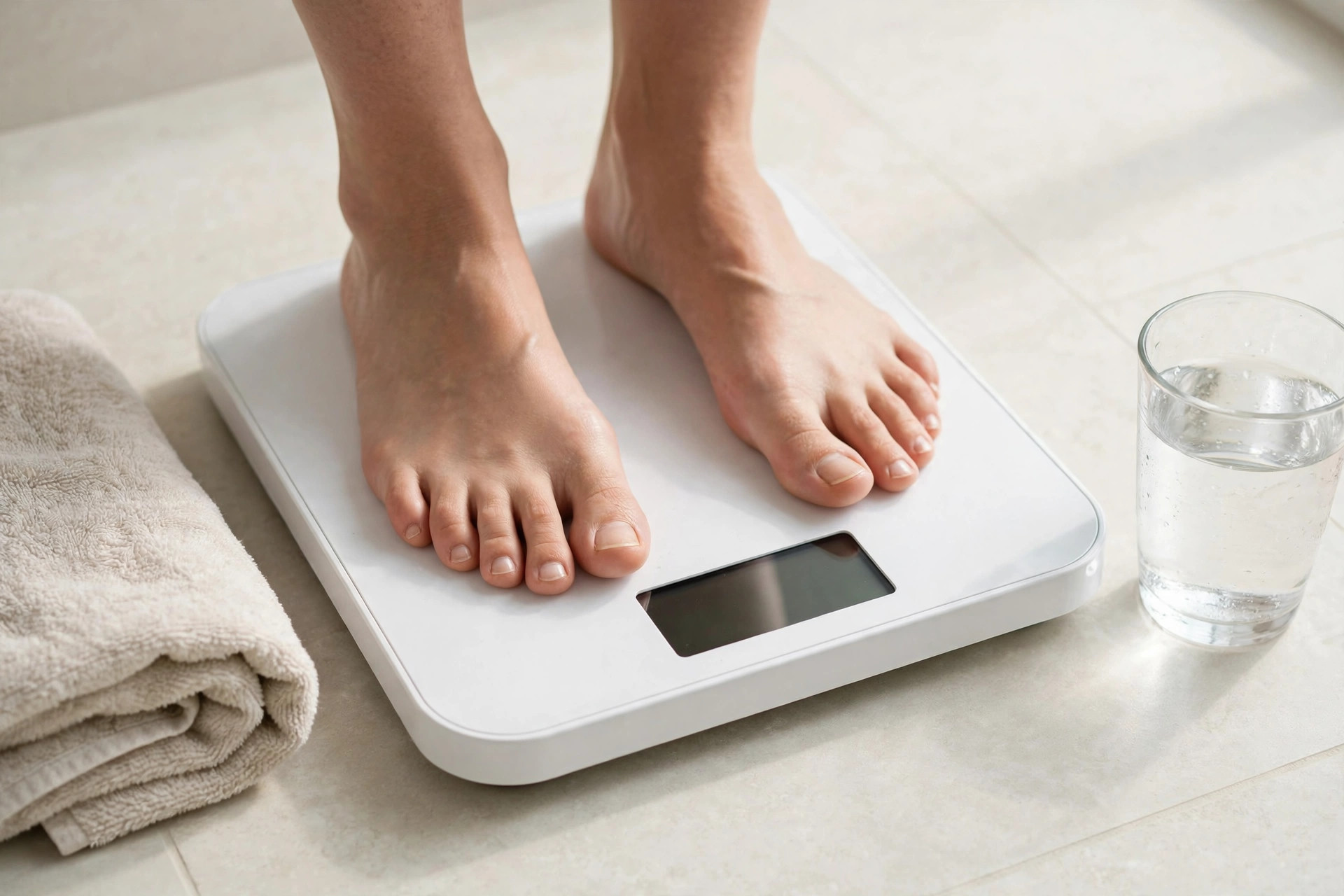
Your weight is not one fixed number — it moves by 1–2 kg across a day as you eat, drink and lose water. At 175 cm, every kilogram is worth 0.33 BMI points, so a 2-kg swing is worth 0.65 points — enough to flip a category. A true weight of 76 kg at 175 cm gives a BMI of 24.8, healthy — but step on the scale after dinner, in jeans and shoes, at 78 kg and the same body reads 25.5, overweight. Nothing about your body changed; only the measurement did. Weigh yourself in the morning, after the bathroom and before breakfast, barefoot, in light clothes, on the same scale, on a hard floor — and compare like with like, never tonight against last week.
4. Rounding your height and weight too early
Rounding feels harmless, but BMI squares your height, so a small rounding gets amplified. Take 74 kg at a true height of 172.5 cm: the BMI is 24.9, just inside healthy. Round the height down to 170 cm — only 2.5 cm — and the same 74 kg now reads 25.6, overweight. The category flipped on a rounding choice, not on any change in the person. The same trap works on weight: at 172.5 cm the healthy/overweight line sits at 74.4 kg, so a reading of 74 kg is 24.9 and a reading of 75 kg is 25.2 — rounding to the nearest kilo can itself decide the category. Keep one decimal place on both numbers and let the calculator round at the end. A tape measure and a scale that reads to 0.1 kg remove this mistake entirely.
5. Using adult cut-offs for a teenager — or a child
The bands everyone quotes — under 18.5, healthy 18.5 to 24.9, overweight 25 to 29.9 — are adult bands. They do not apply under 20, because a growing body is judged against other children of the same age and sex. A 14-year-old who weighs 60 kg at 165 cm has a BMI of 22.0, which looks healthy on the adult scale — but whether that is the 60th or the 90th percentile depends on the exact age in months and the sex, and only a percentile can say. Use the Teen BMI Calculator for anyone aged 2 to 19. The same warning holds in pregnancy: BMI was never designed for a pregnant body, so use the Pregnancy Calculator instead.
6. Treating BMI as a body-fat verdict
BMI cannot tell muscle from fat — it only sees total weight. An 85-kg person at 175 cm scores 27.8, "overweight", whether that weight is a weightlifter with 12% body fat or a sedentary person with 32% body fat. Same number, completely different health picture. Height matters too: 80 kg at 180 cm is a BMI of 24.7, healthy, while the same 80 kg at 170 cm is 27.7, overweight. So never read the number alone. Add a waist measurement — according to NHS guidance, a waist above 102 cm for men or 88 cm for women carries higher health risk — and check your body fat on the Body Fat Calculator. If your BMI is high but your waist and body fat are low, the "overweight" label is the formula's blind spot, not yours.

7. Chasing a single number instead of a band
Healthy is not one magic weight — it is a band nearly 20 kg wide. At 175 cm, anything from 56.7 kg to 76.3 kg counts as healthy, and at 170 cm the band is 53.5 kg to 72.0 kg:
| Height | Healthy weight (BMI 18.5–24.9) |
|---|---|
| 165 cm | 50.4–67.8 kg |
| 170 cm | 53.5–72.0 kg |
| 175 cm | 56.7–76.3 kg |
| 180 cm | 59.9–80.7 kg |
That changes the goal. The 85-kg person at 175 cm does not need a crash diet — they need to reach 76.3 kg, a loss of 8.7 kg, to land at 24.9. Aim for the middle of your band, not the bottom: dieting to the very bottom usually costs muscle as well as fat. Check your own band on the Ideal Weight Calculator, then track your weekly average weight, not a single reading — the trend is the truth, the daily number is noise.
Your 30-second check
Step on the scale tomorrow morning, barefoot, before breakfast, on a hard floor. Enter your weight in kilograms — or pounds, with the unit toggle set to lb — and your height in centimetres, or feet and inches in separate boxes. Read the BMI, then check it against the band in the table above. If you sit within 0.5 points of a boundary — 24.9, 25.0 or 30.0 — re-measure your height before you believe the category: a 2.5-cm rounding error is all it takes to flip it.
Frequently asked questions
Why does my BMI change every day?
Because your weight does. Food, water and clothing move the scale by 1–2 kg in a day, and at 175 cm each kilogram is 0.33 BMI points — so a 2-kg swing moves your BMI by 0.65. Weigh yourself under the same conditions every time — morning, barefoot, before breakfast — and compare weekly averages, not single days.
My BMI says overweight but I exercise a lot — is it wrong?
It may be. BMI cannot tell muscle from fat: 85 kg at 175 cm is 27.8, "overweight", for a lifter and for a sedentary person alike. Check your waist — above 102 cm for men or 88 cm for women adds risk, according to NHS guidance — and your body-fat percentage on the Body Fat Calculator. High BMI with a slim waist and low body fat is usually the formula's blind spot.
What is a healthy BMI for my height?
Healthy is a band, not a single number: BMI 18.5 to 24.9. At 175 cm that means 56.7 kg to 76.3 kg; at 165 cm it is 50.4 kg to 67.8 kg. Find your own band on the Ideal Weight Calculator and aim for the middle of it rather than the bottom.
Can I use the BMI calculator for my teenager?
No — adult cut-offs do not apply under age 20. A 14-year-old at 60 kg and 165 cm has a BMI of 22.0, which looks healthy on the adult scale, but the real answer is a percentile based on exact age and sex. Use the Teen BMI Calculator, which uses the CDC growth-chart percentiles.
References
- All figures in this post were computed from BMI = weight (kg) ÷ height (m)² and checked against this site's own calculators: BMI Calculator, Teen BMI Calculator and Ideal Weight Calculator (accessed 22 November 2026).
- Adult BMI bands follow the World Health Organization classification: underweight below 18.5, healthy 18.5–24.9, overweight 25.0–29.9, obese 30.0 and above (WHO, accessed 22 November 2026).
- Waist-circumference risk thresholds of 102 cm for men and 88 cm for women follow NHS guidance on waist measurement (NHS, accessed 22 November 2026).
- Teen BMI percentiles follow the CDC BMI-for-age growth charts, which compare a child with others of the same age and sex (Centers for Disease Control and Prevention, accessed 22 November 2026).